
Understanding Fistulas: Causes, Symptoms, and Treatment Options in 2026
Fistulas are tube-like connections formed to drain infectious fluids from any long-term infections in the body. A fistula tube can be formed anywhere in your body; the ones formed in the anal region are called anal fistulas.
They are quite common—especially for those in the age group 30–50 years. It is natural to feel hesitant to ask for help when having fistulas, as the topic itself is a bit awkward and the term also sound scary. So here is a guide to the whats and whys of fistulas—to help you understand all about it. By the end of this article, you will feel a bit braver to face your fistula, despite all the fear around this condition.
What is a fistula in simple terms?
- Very simply put, a fistula is an abnormal tube or tract. It is not a malignant growth, meaning, it forms specifically into a tube-like connection, with a clear start and end.
- It generally forms when there are long-term infections, inflammation or in response to injury after surgery.
- It can be formed between two organs or between an organ and the skin.
- Some locations where fistula tracts can be formed are between the intestine and skin, cervix and vagina, stomach to the skin surface, anal glands to the skin etc.
- Anal fistulas specifically form when there are infected anal glands.
- There are about 8–10 anal glands which are present in your anal canal. They make mucus which can help your bowels to move smoothly out of the anal canal.
- Sometimes these glands get infected due to some small debris, or even faecal matter entering them. That time they release a lot of pus which gets collected into pockets called perianal abscesses.
- To drain the pus from these pockets, your body will form the fistula tract from this pocket to an opening in the skin.
- As a result, you may feel constant wetness where it drains out, along with pain, itchiness, and skin irritation. You may also observe a foul smell and blood from this liquid.
When should I worry about a fistula?
- As a rule of thumb, you must remember—you are never too early for worrying about a fistula.
- Here is why: a fistula tract begins at the infected pocket of pus or abscess. It ends at the opening in the skin of your buttocks. When a fistula is initially formed, it is a simple straight tube like this.
- But this tract remains as such even after the liquid all drains out. Many times, if left as such, the tract can even branch out to make more tube-like structures (you can imagine it like going from a simple root of a small plant to the branched roots of a big tree).
- When they become branched out, they go through a lot of anal muscles and even sometimes through your anal sphincter muscles (which are very important to control bowels).
- Fistula tracts can never go away by themselves and always require surgery to remove them. Procedures which involve cutting through anal sphincter muscles in general require more sittings for their removal and more recovery time. Thus, you can now understand why treating a fistula when it is in the starting stages is the most optimal.
- Here are some symptoms to watch out when you should be worried about an anal fistula:
- Persistent drainage: Drainage can be continuous or irregular with pus, blood, or faecal matter from a small hole near the anus.
- Recurring abscess: Since the fistula tract remains open, it repeatedly allows bacteria to enter it, this causes reinfection at the same spot.
- Throbbing pain: Throbbing pain which can worsen while sitting, walking, or during bowel movements.
- Skin irritation: Constant redness, and itching caused by the continuous liquid drainage.
- Other infection signs: Due to the infection, fever, chills, and fatigue can occur.
What is the Rule of 3 (Goodsall’s Rule) in Fistula?
Fistulas have been forming since ever, which means they used to get diagnosed and treated even before MRI and other imaging methods were there.
Since fistulas are tubes which can be formed in any shape or at different positions in the anal region, how did the doctors know where the tubes were and where they need to make the surgical cut?
Well, they use something called a Goodsall’s Rule for knowing what they are dealing with.
- This rule was formed in the late 1800s by an English surgeon Dr. David Henry Goodsall.
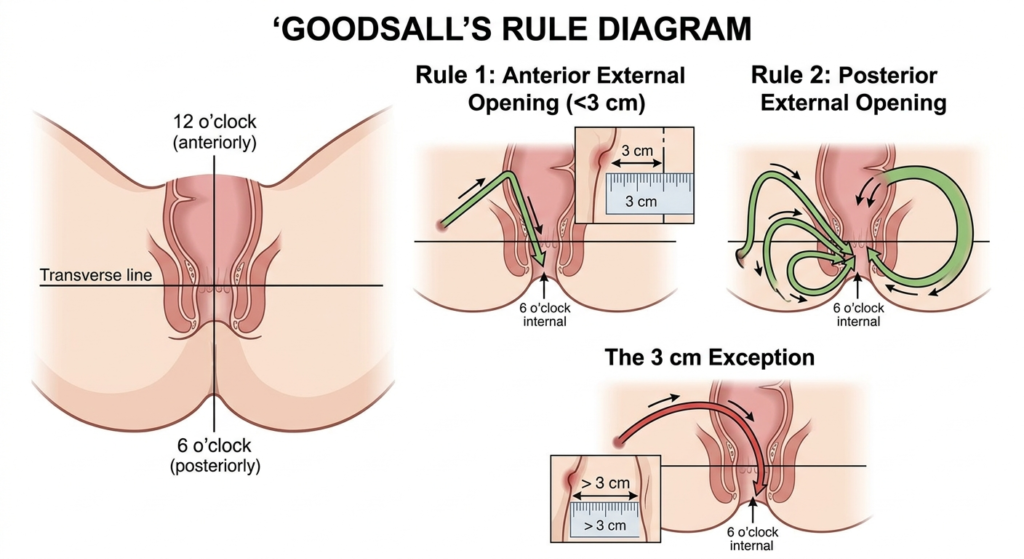
- It is an important rule followed by fistula surgeons to help them predict what path (shape) the fistula is taking, or where the internal opening (inside end) of the fistula tract is based on where the external opening (outside end) is located.
- This rule is like a surgeon’s map, and helps them understand if it’s a simple or complex fistula.
- Goodsall’s rule is based on the location of the external opening of the fistula with relation to a sleeping/horizontal line drawn across the anal canal.
- The doctor considers the anal canal as a clock face. When the patient is lying on the back, they imagine a sleeping/horizontal line drawn across the anal canal/hole.
- Imagine the anal area as a clock face while you are lying on your back:
- 12 o’clock is toward the front (genitals).
- 6 o’clock is toward the back (tailbone).
- A horizontal line is drawn right through the middle.
- Based on this line, the rule states that—
- If the fistula opens in the front side: If the external opening is front (towards genitals) to this horizontal line, the fistula tract will generally follow a straight line to the anal canal. This is called an anterior fistula.
- For fistulas opening on the back side: If the external opening is behind the transverse line (towards the tailbone), it generally is formed in a curved path or may have a horseshoe pattern. This is called a posterior fistula.
- However, there are always exceptions to every rule, right?
- So here too, there is a 3 cm exception. If the external opening is in the front half but is more than 3 cm away from the outer edge of anal hole, the fistula usually ignores the “straight line” rule. Instead, it acts like a back-side fistula—curving all the way around to enter at the 6 o’clock position.
- Why does this matter? By predicting this path, your surgeon can plan a surgery that clears the infection while carefully protecting the vital muscles that control bowel movements.
Fistulas naturally sound scary and complex. It is important to remember that the underlying cause is typically an infection. If left untreated, this infection can potentially spread to the bloodstream—leading to a serious condition called sepsis. Furthermore, delaying treatment allows a fistula to “branch out” and become more complex over time, making it harder to resolve.
The good news is that you don’t have to live with the discomfort or the worry. This article hopes to dispel some of the fear around this topic by throwing light on its basics. They key is always to go to a colorectal specialist as early as possible. In 2026, medical advancements have changed fistula treatment into a process that can often be resolved in just a week.
At Smiles Gastroenterology Centre, Bangalore, the doctors are equipped to do just that. They ensure to tailor the treatment approach to personally suit your unique fistula tract to deliver effective and lasting solutions. Choose Smiles Gastroenterology today to regain your confidence, comfort, and smiles.