
Fistula is an abnormal tract formed when your body needs to remove infectious fluid build-up from long term infections. The most well known of the fistula types is the anal fistula, which forms in and around the anal canal. When the glands lining the anal canal get infected, there is significant amounts of pus formed. It is drained out through the fistula tube/tract.
However, the tract still remains even after all the infectious liquid is drained out, which can lead to further branching of the tract and reinfected glands. It is natural to think that fistulas can be cured with antibiotics or other medications since a fistula tract forms after long-term infections. However, all medical reports show evidence that unless a tract is surgically removed, it does not get cured.
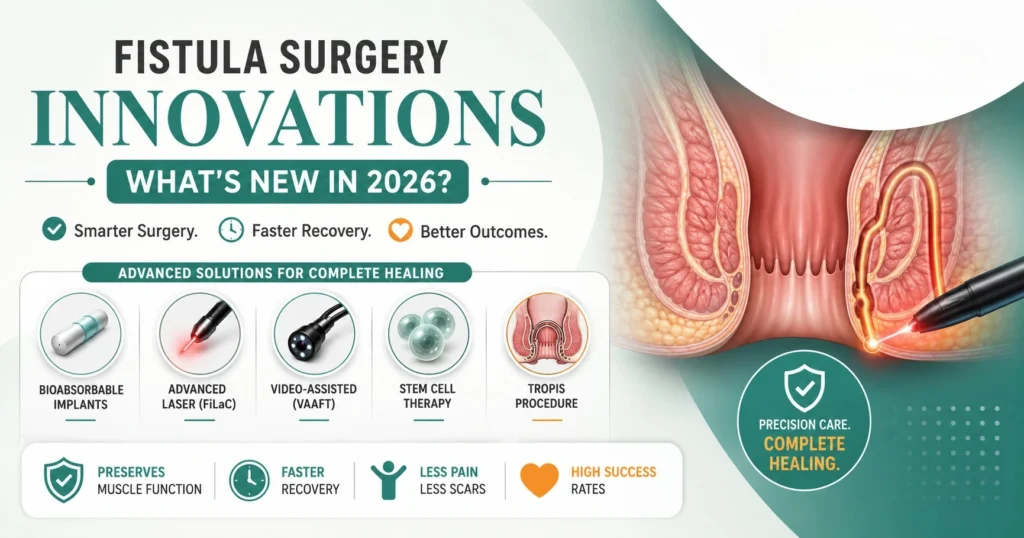
The field of fistula removal has improved vastly both in terms of being less invasive and less painful. What was being done with a knife and scalpels, leaving behind big scars, painful and long recovery time, and unintended cuts to surrounding healthy muscles are now being done with precision lasers, guaranteeing minimal blood loss, and faster recovery time. Read on to know more about the latest in the fistula recovery field.
What’s the new treatment for fistula in 2026?
Fistula removal surgeries now go beyond just minimal blood loss or scarring. They focus on precision cutting to avoid any damage to sphincter muscles (which help control stool movement), thereby reducing the pain and recovery time after the surgery. Some of the latest treatments for fistula are:
1. Bioabsorbable Implants: This is one of the latest innovations for fistula treatments which has been recently approved by the FDA. This advanced method involves placing a tiny implant directly into the fistula tract. This implant will help compress and close the tract without cutting the surrounding muscles. Over several months, the body naturally absorbs the implant while the tissue heals over, leaving no permanent foreign material behind.
2. Advanced Laser Therapy (FiLaC): This approach uses a flexible laser fiber inserted into the fistula tract to deliver precise and controlled heat energy. The heat safely closes the fistula tract walls to collapse and seal shut. This technique is currently being widely practiced in India and is well-known for being a painless and one-day procedure.
3. Video-Assisted Anal Fistula Treatment (VAAFT): Fistula tracts begin as a single tract/tube. Over time if left untreated, they can branch out to form extra tracts and thus, complicate the treatment options. VAAFT is designed for such complex or branching fistulas. It utilizes a tiny high-definition camera inserted into the tract to give surgeons a visual map of the branches. They are then safely sealed with an electrode without damaging any surrounding healthy muscles or the sphincter muscle.
4. Regenerative Stem Cell Therapy: This is mainly used for fistula tracts caused by long-term conditions like Crohn’s disease. This therapy involves injecting specialized stem cells directly into the surrounding tissue. It relies on the body’s natural communicative processes to regenerate and close the tract.
5. TROPIS Procedure: TROPIS is a specialized surgical innovation used for deep, more complex, or horseshoe-shaped fistulas that are difficult to treat using VAAFT. By opening only where the infection originates for draining and healing, it eliminates the fistula while keeping bowel control.
Informative side note: While the Bioabsorbable implants and stem cell therapy are yet to enter the Indian medical practice, FiLAC and VAAFT are currently almost daily used treatment options for the common fistula cases.
What is the gold standard treatment for fistula?
- Fistulas are tracts formed to drain out infectious liquids from inside the body. even after its job is done, when left as such, it branches out from a single tract to resemble something like a horse-shoe or a branched-out tree root.
- In India, there are a couple of widely used procedures, considered as gold standard for each type of fistula—simple and complex.
- For simple fistulas:
- Nothing beats a simple fistulotomy which involves opening the fistula tract along its length and laying it out to dry. The success rates of this procedure for simple fistulas are a huge 85–98%, with very low recurrence rates (2–7%).
- FiLAC remains to be the gold standard of treatment for simple fistula tracts which have a straightforward path and do not involve any sphincter muscles. It is painless, leaves virtually no scars, and due to its precise nature does not touch any surrounding healthy muscles.
- For complex fistulas:
- VAAFT remains to be the most widely used procedure which involves using video assistance to map out branches and seal them right from the tips to the main fistula tract.
- Ksharasutra is an ayurvedic procedure backed by the Indian Council for Medical Research (ICMR) . It involves using a medicated thread to insert into the fistula tract and help in healing the infection and seal the tract is also still used for fistulas. However, this procedure needs multiple sitting to remove and re-insert the thread till complete healing happens.
How risky is the anal fistula surgery?
- The commonly used anal fistula surgeries mentioned above are very often well tolerated by patients across the Indian population.
- Here are some numbers which indicate the success rate of each of the techniques used for fistula treatment in 2026 in India:
- Fistulotomy: 85–95%
- FiLAC: 70–85%
- VAAFT: 70–80%. However, many skilled colorectal surgeons often combine VAAFT with lasers or specialised flaps in the same session, bringing the overall success rates to 90% even for complex fistulas.
- Ksharasutra: 95–98%
- However, there is no procedure without risk factors which come along with it. The major risk factors in any fistula surgery is the development of faecal incontinence.
- The sphincter muscles in the anal canal are majorly involved in controlling the bowel movements. They act to hold in stools until you are ready to push them out. During fistula removal, any cuts to the sphincter muscles risks their healing, and consequently their functioning.
- This risk is notably higher for complex fistulas that cross deeply through the muscle layers.
- Other general risks include minor post-operative pain, bleeding, delayed wound healing.
- Fistula recurrence is also another risk in the range of 2–21% . However, this happens only if the entire tract isn’t fully cleared.
- The introduction of modern, minimally invasive techniques such as precision lasers (FiLaC) and video-assisted treatments (VAAFT) has reduced these complications to allow for almost zero risk to muscle function and a much safe recovery.
Anal fistula treatment has evolved from a painful, invasive ordeal into the age of precision and patient comfort. With advanced innovations like FiLaC and VAAFT you can choose for complete recovery and no functional loss of sphincter muscles. By eliminating aggressive tissue cutting and preserving vital sphincter muscles, these modern techniques ensure minimal pain but effective treatments.
However, the choice of procedure will always depend on how complex the fistula tract is. Skilled colorectal specialists at Smiles institute Gastroenterology, Bangalore can help you choose the exact personalised treatment out of all of the latest above-mentioned innovations which they specialise in, for your fistula. Thus, if you are dealing with a fistula, you no longer need to delay treatment out of fear; today’s medical treatments mean a safer, gentler, and a complete healing path.