
Fistula sounds like a scary term when you hear it from your doctor. Very naturally so, as the term is not used usually in common conversations. The pain and fear feel much bigger especially when you think you just have piles, or just a small boil, but it turns out it is deeper than that, and with a scarier name too. This informative article has been written with exactly those feelings in mind. What is a fistula, are they worrisome, will they ever go away, and how long does it take? By the end of this blog, you will be much more confident knowing the ins and outs of this condition. After all, throwing light on the unknown is the first step to dispelling fear.
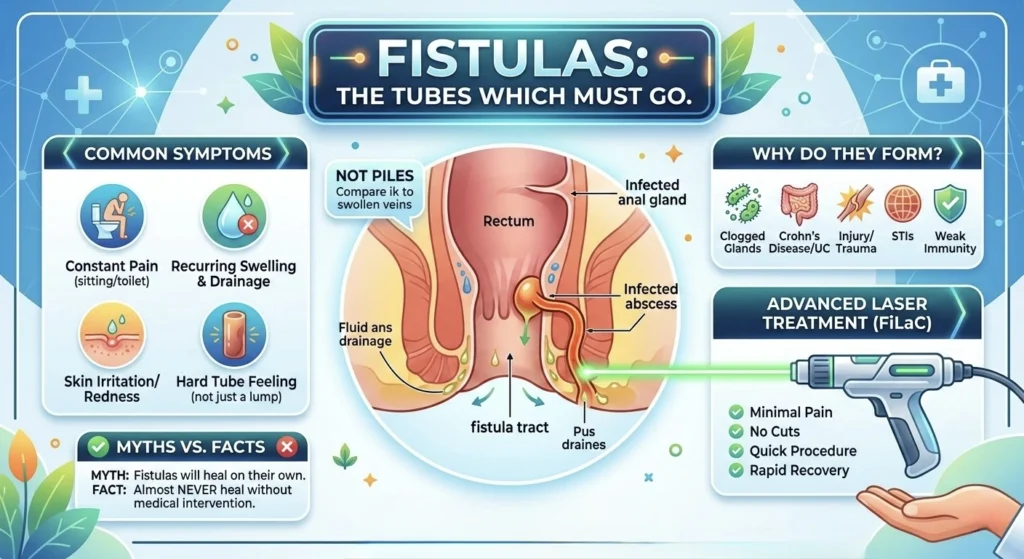
Firstly, what is a fistula?
Well, a fistula is a medical term used for abnormal tube-like connections formed in the body. They can be formed anywhere in the body, and are formed in response to long-term infections to drain liquids out of the body. These connections can be found in the intestines (connecting the intestines to the skin), genital or pelvic regions (between vagina and bladder), and in the skin (infected skin to surrounding healthy tissue). But the most common type occurs in the anal area, where an infected anal gland is connected to the skin. A fistula is not considered a malignant growth.
Why do fistulas form?
Many times, we cannot identify an underlying infection in the body. In majority of the people, the body can naturally clear any small infections with ease. Sometimes the site of infection, like an infected anal gland, harbours residual microbes which can re-infect this site repeatedly. When the infection keeps repeating, it is termed as chronic/long-term infection.
Long term infection also means continual collection of fluids and pus. To drain this liquid out, the body needs a continually opened channel, similar to a tube that continuously drains fluids. Thus, it forms a tube-like structure which is termed as a fistula. A fistula functions to clear the site of infection by draining out infectious liquids. The whole tube-like structure from the beginning to the end is called as a fistula tract.
Know more about anal fistulas:
Fistulas formed in the anal regions are called anal fistulas. They cause pain (while sitting or using the toilet), bleeding, and irritation. Due to these overlapping symptoms with other anal conditions like piles, and fissures, it is natural to mistake a fistula with piles.
Some distinguishing and must-know symptoms of anal fistulas are:
- Pain is often constantly present—it can worsen during sitting or using the toilet, but is there even without any pressure in this area.
- Swelling and drainage—this occurs because of the constant liquid accumulation in the abscess. The swelling is accompanied by increase in pain around it. This is followed by a popping sensation, and then drainage of fluids where the fistula opens in the skin area. Persistent drainage is the most tell-tale symptom of an anal fistula.
- Skin irritation—The outer skin is regularly exposed to infectious fluids, and sometimes even faecal matter which has drained from the fistula tract. Thus, there would be redness, and itching in the skin around the fistula.
- Feeling of a hard tube-like structure near the site of discharge. Piles always feels like a lump which hangs out from the anal canal. Fistulas feel like there is small tube underneath the skin, which is not hanging near the anal opening.
Why are anal fistulas formed?
An anal fistula is formed mainly due to infected anal glands. The inner lining of the anal canal has several anal glands which secrete mucus to make the passage of stools smoother. When these glands get blocked, they get infected. Infected glands release pus, which collects in pockets near them called abscess. To drain the pus, your body creates the tunnel-like structure called a fistula.
There are several reasons for an anal gland to get infected:
- Clogged glands: This stands to be the most common cause of fistula formations to date. When the internal anal glands get clogged with liquid, bacteria, or faecal particles, they get infected and form abscess. When the abscess remains for a long time, the body creates a fistula to drain the liquid out. While this can happen to anyone, it is most frequently seen in adults between the ages of 30 and 50.
- Conditions like Crohn’s disease and Ulcerative Colitis: These diseases cause long-term inflammation in the intestines which can thin down its walls. This makes them more susceptible to forming fistula channels.
- Traumatic injury or previous surgery in the anus: Very rarely, any previous surgery for piles or fissures can result in fistula if the tissues do not heal properly.
- STIs: Sexually transmitted infections can make the anal glands infected, resulting in fistula tract formation
- Anal Tuberculosis: Although less common, anal TB can also cause recurring fistulas.
- Weakened immunity from conditions like repeated radiotherapy of the pelvic region, or diabetes can make the immune system too weak to fight infections. This naturally makes the it easier for fistula formation.
What is the way forward for fistula treatment?
It is natural to believe that treating the underlying infection cures the fistula. This is unfortunately not the case, and fistula tracts always need surgery for permanent relief.
- When you visit your doctor, you may be prescribed antibiotics and painkillers. These are only for managing the symptoms of the fistulas.
- Often the fistula is deeply embedded and hence, not accessible to antibiotics. Thus, taking antibiotics for fistula is to keep the infection from spreading to other body parts.
- Using other means of relief like sitz baths, and regularly washing the anal area only help to keep the fistula tract clean, and prevent re-infections.
Empty fistula tracts may not necessarily cause any particular symptom like discomfort or pain unless there is an active infection. However, leaving a fistula tract untreated can complicate matters as they branch out and form complex fistulas. Complex fistulas can be imagined as structures which look similar to the roots of a tree. It can be easily understood now, as to why surgery for the tract removal is much easier when the fistula tract is just a single tube, like when it forms.
How painful is a fistula surgery?
There is no single best surgery for fistula. A colorectal surgeon will decide the treatment option based on the type of fistula seen after using imaging techniques like MRI defecography.
Form simple fistulas, a technique called fistulotomy proves to be the most successful fistula surgery, with success rates as high as 95%. This is used for fistula tracts which are straight-forward, and do not go through many anal muscles.
For fistula tracts which have either branched out to form multiple tracts, or the single tract goes extensively through anal muscles, a procedure called FiLaC (Fistula-tract Laser Closure) remains to be the most advanced and chosen form of fistula treatment.
Here high-precision laser is used to remove the fistula tract for permanent recovery. It is highly opted due to its painless and no-cut procedure. This procedure takes only about 45 minutes to get done, and most patients go home on the same day itself. There is also a near-zero risk of faecal incontinence with FiLaC as there is no damage to any anal sphincter muscles which help control bowel movements.
Some myths and truths about anal fistulas
There are several myths regarding anal fistulas and their treatments. Here are some common ones, and their explanation to why they are just myths.
| Myth | Truth |
| Fistulas are nothing but severe piles | Piles and fistulas have overlapping symptoms like pain, itching, and bleeding. They also broadly occur in the same anal region. These points can naturally make it difficult for any common person to differentiate between the two. A simple explanation: piles are swollen veins, and fistulas are tube-like structures. |
| Fistulas are caused by poor hygiene | Most fistulas start from an infected anal gland or an abscess. They can also be linked to conditions like Crohn’s disease or trauma. While hygiene is important, and can prevent anal gland infection, it is not always the cause. |
| Fistulas can be treated only with antibiotics | Antibiotics can help with containing the infection, and clearing the pus. However, the fistula tract will remain as such till surgery is used to seal the tract. |
| Fistulas can heal on their own, given enough time | Unlike a small cut or a minor case of piles, a fistula almost never heals without medical intervention. In fact, waiting allows the tunnel to become more complex or can lead to recurring infections. |
| Once the fistula tract is empty, and it does not hurt, it can be ignored. | Some fistulas are painless at first or only “flare up” occasionally. However, untreated fistula sometimes can even lead more severe tissue damage over time. In rare cases, the infection can spread and cause sepsis. |
| Surgery always means pain, and needs long time investments. | Modern treatments, such as laser surgery like FiLAC, are minimally invasive. Many patients go home the same day and return to light activities within 24–48 hours. |
If you can take one thing from this guide, it is that an anal fistula is a structural problem, commonly occurring, and caused by many factors apart from hygiene. While the term sounds scary and the symptoms are truly uncomfortable, medical advancements have made its treatment very easy to treat.
Hence, do not ignore the cycle of pain and drainage, as it only allows the condition to become more complex. Address it early, even though it may just feel like a boil. This is the fastest way to return to a life free from discomfort and worry.